
Last updated October 16, 2026






Free written scope consultation - allowances, timeline, and change-order rules on paper before a single trade is scheduled
How to Hire a Construction Contractor in Sacramento: A Step-by-Step Guide
Here’s a number that should reframe how you think about hiring a contractor: the California Contractors State License Board received over 18,000 complaints in a recent year. The uncomfortable detail buried in that figure is that most of those complaints involved contractors who were licensed and insured at the time they were hired. A clean CSLB lookup is the beginning of due diligence, not the end of it.
In this complete guide to construction in Sacramento, you’ll learn the full hiring sequence we recommend to Sacramento homeowners: how to verify a license properly, how to read a contract so it protects you instead of the contractor, how to compare three bids that don’t look alike, and what questions to ask references that actually surface problems. We’ve built and remodeled homes across Sacramento for years, and we’ve seen where the process breaks down. It almost always breaks down at the contract stage, not the handshake stage.
Styles & brands we work with







Quick Answer
To hire a construction contractor in Sacramento, verify the license on the CSLB website, confirm workers’ compensation insurance, get three written bids with matching scope inclusions, call references with specific questions about schedule and invoicing, then review the contract line by line before signing. The contract is the final gate: allowances, exclusions, change-order procedure, substantial completion, and lien release language must all be in writing before any money changes hands.
Table of Contents
- Step 1: Verify the License on the CSLB Website
- Step 2: Confirm Insurance and Bond Coverage
- Step 3: Get Three Bids and Normalize the Scope
- Step 4: Call References With Questions That Reveal Problems
- Step 5: Review the Five Contract Clauses That Protect You
- Step 6: Sacramento-Specific Red Flags to Watch For
- Common Mistakes to Avoid
- When to Call a Professional
- Frequently Asked Questions
Step 1: Verify the License on the CSLB Website
Every contractor doing work over $500 in labor and materials in California must hold a valid license from the Contractors State License Board. The lookup tool at cslb.ca.gov is free and takes about two minutes. Enter the contractor’s name or license number, and you’ll see the license status, classification, issue date, expiration date, any workers’ compensation coverage on file, and any disciplinary actions.
Here’s what the status designations actually mean for your risk:
- Active: The license is current and the contractor can legally work. This is the minimum requirement. It tells you nothing about how the contractor performs.
- Suspended: The contractor cannot legally perform work. Suspensions happen for failure to maintain a bond, failure to maintain workers’ compensation insurance, or disciplinary action. Walk away.
- Clear: This appears on the license detail page and means no disciplinary actions are currently pending. A “clear” designation combined with “active” is what you want to see.
- Expired: The contractor let the license lapse. Some contractors work on expired licenses and renew only when a job requires it. Don’t accept this. An expired license means no bond coverage, no insurance requirement, and no CSLB recourse if the job goes sideways.
In Sacramento, we also check whether the contractor’s license classification matches the work. A “B” classification covers general building contractors, which is what most whole-home and kitchen remodels require. A “C” classification covers specialty trades like electrical (C-10), plumbing (C-36), or HVAC (C-20). If a general contractor is pulling electrical or plumbing work, they need subs with the right classifications. Ask to see the sub list before work starts.
The CSLB also maintains a complaint disclosure database. If a complaint was filed and investigated, it shows up. Read it. A single resolved complaint from a decade ago shouldn’t disqualify anyone. A pattern of complaints about contract disputes, failure to complete work, or poor workmanship should.
Step 2: Confirm Insurance and Bond Coverage
License verification and insurance verification are separate steps, and skipping the second one is a common mistake. A Sacramento contractor can hold an active license with zero insurance coverage on file. That’s legal in California for some classifications, but it means if a worker is injured on your property, the claim could land on your homeowners insurance.
Ask for a certificate of insurance directly from the contractor’s carrier. Don’t accept a copy of a policy from the contractor’s binder without checking with the carrier, because policies lapse. Three coverages matter:
- General liability: Covers damage to your property caused by the contractor’s work. $1 million per occurrence is standard for residential work in Sacramento.
- Workers’ compensation: Covers injuries to workers on your job site. California requires it for any contractor with employees. This is the one that protects you from a lawsuit if a worker gets hurt on your property.
- Contractor’s bond: Required by the CSLB. The standard bond is $25,000, which covers you if the contractor violates the contractor license law, uses unpermitted work, or abandons the job mid-project. It’s a backstop, not a replacement for a good contract.
Call the insurance carrier and confirm the policy is active. This takes five minutes and closes the gap between what a contractor claims and what’s actually in force. We’ve seen Sacramento homeowners skip this step and discover later that the policy lapsed six months before their project started.
Step 3: Get Three Bids and Normalize the Scope
Three bids is the classic advice, but it’s incomplete. Three bids with three different scopes aren’t comparable. One contractor includes demolition and hauling. Another assumes you’ll handle it. A third quotes a lower cabinet grade without saying so. You end up comparing numbers that don’t describe the same project.
Before you solicit bids, write a scope document. One page listing what’s included: demo, hauling, framing, rough-in, finish work, painting, cleanup. Same kitchens, same materials to the extent possible. Then hand that same document to all three contractors and ask them to bid it as written.
When the bids come back, normalize them:
- Check for inclusion gaps. Does Bid A include demolition and Bid B doesn’t? Add the missing line item to Bid B before comparing.
- Check allowances. Allowances are placeholder dollar amounts for materials not yet selected. A $5,000 cabinet allowance means the contractor allocated $5,000 for cabinets. If you pick cabinets that cost $8,000, the price goes up. Compare allowance amounts across bids, not just bottom lines.
- Check for exclusions. Some bids exclude finishing, trim, paint touch-up, or debris removal. These are real costs that will show up somewhere, either on your invoice or on your weekend.
- Compare the markup. Some contractors work on a cost-plus model, others on fixed price. Fixed price is safer for a homeowner. Cost-plus means you pay whatever the job costs, plus a percentage. If the estimate was low, the final number won’t be.
- Look at the payment schedule. California law caps the deposit for home improvement work at 10% of the contract price or $1,000, whichever is less. Any contractor asking for more than that up front is testing you.
In Sacramento’s market, mid-range kitchen remodels typically run from $35,000 to $75,000, whole-home remodels from $150,000 to $400,000 depending on square footage and finish level; for deeper numbers, see our construction cost breakdown for Sacramento homeowners. Those are rough bands, not quotes. What matters more than the number is whether the bid describes the same job. At Bradford Remodeling Co Sacramento, we give a written price before any work starts, with allowances broken out and exclusions listed, so the number you sign is the number you pay.
Step 4: Call References With Questions That Reveal Problems
Most reference calls are a waste of time because the questions are too soft. “Were you happy with the work?” elicits a yes and ends. The contract problems, schedule slips, and invoice surprises surface when you ask about specific behaviors. Ask these questions:
- “Did the final invoice match the contract price?” If the answer is no, ask how much it changed and why. This is the single most revealing question you can ask a reference.
- “Did the crew show up when they said they would?” Not “were they professional.” Did they show up. Schedule reliability is where most contractors fail, and it’s rarely captured in a general satisfaction question.
- “Were there any change orders during the job?” Then ask if the change orders were handled in writing and priced before the work was done. Verbal change orders are where cost overruns live.
- “Did the project finish on the date they estimated?” Then ask how far over it ran. Every remodel runs late sometimes. What you’re looking for is whether the delay was communicated or discovered.
- “Would you hire them again for a project of the same size?” Then wait. The pause before the yes is the honest answer.
Ask for references from projects completed at least a year ago. A contractor’s workmanship holds up or it doesn’t. A reference from six months ago tells you the job got finished. A reference from three years ago tells you whether it stayed finished. The 365-Day Done Right Promise we put in writing exists because workmanship problems sometimes show up months after the crew leaves. Ask the reference whether the contractor came back to fix anything after the job closed, and whether they charged for the visit.
Step 5: Review the Five Contract Clauses That Protect You
The contract is where the hiring decision actually happens. Everything before it is screening. The contract is the document that binds the scope, the price, the schedule, and the remedy if something goes wrong. If a Sacramento contractor hands you a one-page contract and says the details will work themselves out, that’s your cue to stop and ask for the details in writing. Vague language is legal cover to charge more and deliver less.
These are the five clauses you need to read carefully before signing anything:
1. Allowances
Allowances are dollar amounts allocated for items you haven’t selected yet, like cabinets, countertops, tile, or fixtures. A well-written contract lists every allowance, the dollar amount, and what it covers. A poorly written one buries allowances in a single line. If you select materials that exceed the allowance, the difference is added to your final price. That’s normal and fine. What’s not fine is discovering the allowance was unrealistically low to keep the bid looking competitive, then getting a change order for the real number a month later.
2. Exclusions
Exclusions are the line items that are explicitly not part of the job. Some exclusions are legitimate: the contractor doesn’t handle landscaping restoration, or painting is excluded, or the homeowner is responsible for moving furniture. The problem is undisclosed exclusions. If the contract doesn’t say who patches drywall, removes debris, or repaints baseboards, the contractor can reasonably claim it wasn’t in the scope. Read the exclusions section line by line and ask what’s missing.
3. Change Order Procedure
Change orders happen on nearly every remodel. The question is how they’re handled. A proper change order is a written document that describes the change, states the price adjustment, and is signed by both parties before the work changes. If a contractor says “we’ll handle it and settle up at the end,” that’s a red flag. By the end, you have no leverage and a stack of verbal changes that became a large invoice. The contract should state that no work changes without a signed change order.
4. Substantial Completion
“Substantial completion” is the point when the project is functional enough to use, even if punch-list items remain. Why does it matter? Because that’s often when a final payment is due. If the contract defines substantial completion loosely, the contractor can declare the project complete while the cabinet doors are misaligned and the paint is unfinished. A good contract defines substantial completion with specificity: all fixtures installed, all inspections passed, all systems operational, punch list documented in writing. It also holds back a retention amount, commonly 5-10%, until the punch list is actually done.
5. Lien Release Requirements
Here’s the clause most Sacramento homeowners never think about until a lien shows up. Your contractor hires subcontractors and buys materials. If the contractor doesn’t pay the subs or suppliers, those parties can file a mechanic’s lien against your property, even though you paid the contractor. A contract should require the contractor to provide conditional and unconditional lien releases from every sub and supplier as payments are made. The releases need to be in hand before you make each progress payment. If a contractor is vague about lien releases, ask directly: “Will you provide conditional and unconditional lien waivers from all subs and suppliers with each draw?” The answer should be immediate and yes.
This is what we mean by by-the-book. At Bradford Remodeling Co Sacramento, allowances, exclusions, change order procedure, completion definition, and lien release language are written into every contract before a single tool comes out. The Garrison Standard exists for exactly this reason: homeowners in Sacramento have been burned by contracts that read like blank checks, and the fix is specificity in writing. Our home remodeling work in Sacramento is documented before it’s built, so the number you sign is the number you pay.
Step 6: Sacramento-Specific Red Flags to Watch For
Some contractor behaviors are red flags anywhere. Others show up with particular frequency in Sacramento’s market. Here are the ones we tell our neighbors to watch for:
- Pulling permits after work starts. In Sacramento, remodeling work that changes structure, electrical, plumbing, or mechanical systems requires permits from the city’s Community Development Department. A contractor who starts the job and says they’ll pull the permit “later” is asking you to absorb the risk of unpermitted work. The permit needs to be pulled before the work requiring it begins. If the inspector shows up to an open wall with no permit, you’re the one who pays to fix it.
- Refusing to put guarantees in writing. A contractor who says “we stand behind our work” but won’t put the terms of that guarantee in the contract is telling you something important. A verbal guarantee is not a guarantee. If the work fails and the only remedy is a phone call, you have no remedy. The 365-Day Done Right Promise we provide is written, signed, and specifies exactly what happens if the work doesn’t hold.
- Quoting time and materials on a fixed-scope job. Time and materials means you pay for labor hours and materials used, whatever that adds up to. It’s appropriate for exploratory work where the scope is genuinely unknown. It is not appropriate for a kitchen remodel, a bathroom remodel, or a whole-home renovation where the scope is visible and definable. If a contractor proposes T&M on a job with a defined scope, they’re telling you they don’t want to stand behind a number. Walk away or demand a fixed price.
- The door-dash on pricing. A contractor gives you a verbal estimate, you sign an intent, and the formal contract arrives with a higher number. Sometimes the higher number is legitimate: unforeseen conditions, scope changes, material selections. But if the line items don’t explain the difference, that’s a signal the first number was a sales tool, not an estimate. Get the price in writing before you commit to anything.
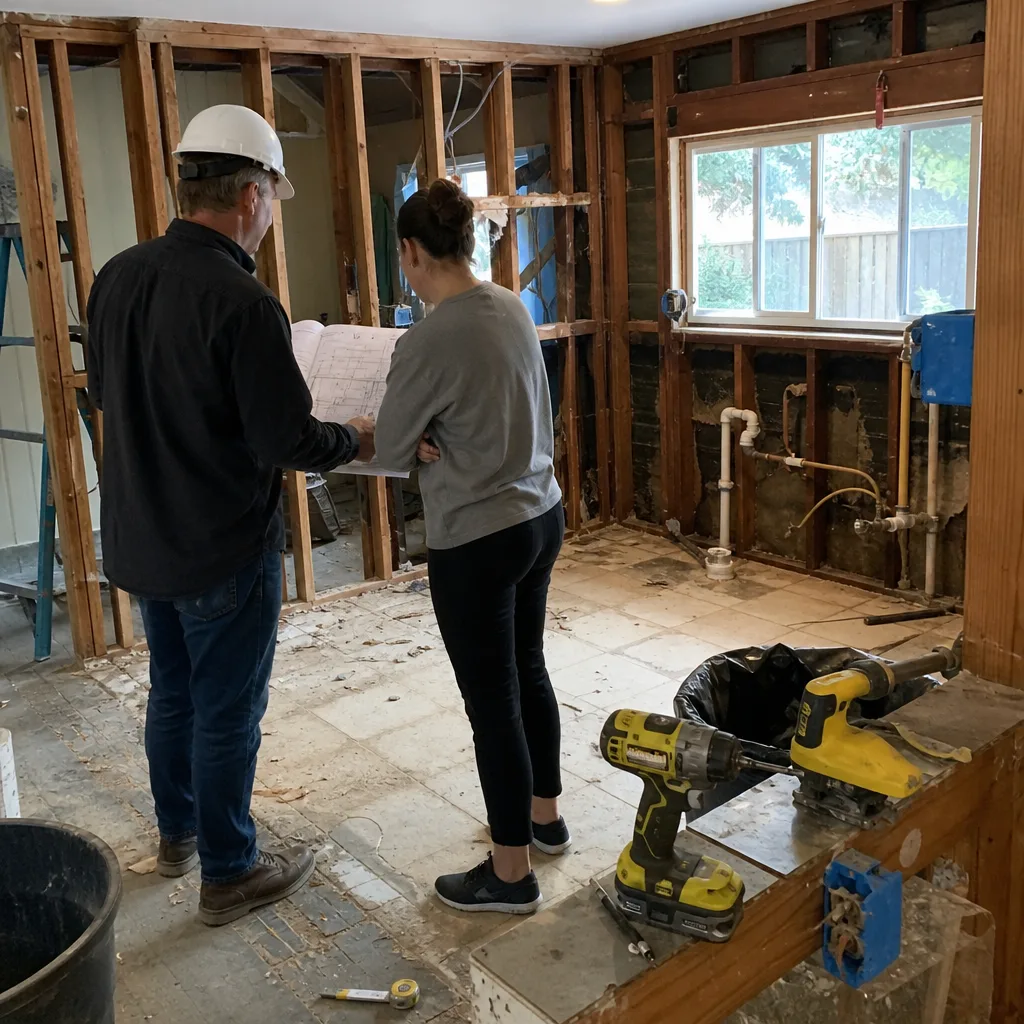
Sacramento’s older housing stock adds a layer. Many homes in neighborhoods like East Sacramento, Land Park, and Curtis Park were built in the 1930s through 1950s and have plaster walls, knob-and-tube wiring remnants, and cast-iron drain lines. A contractor who doesn’t flag these as potential cost items during the bid phase is either inexperienced with the market or planning to discover them later as change orders. Ask directly: “Given the age of this house, what do you expect to find when you open the walls?” A good contractor gives you a straight answer with a contingency number attached.
Common Mistakes to Avoid
- Hiring on price. The lowest bid is sometimes the lowest because it omits scope. If one bid is 30% below the others, the question isn’t “what a deal” but “what’s missing.” Ask the contractor to explain the gap in writing.
- Skipping the permit conversation. In Sacramento, unpermitted work can affect your ability to sell the home and can void your homeowners insurance on a claim involving that work. Ask whether the contractor pulls permits and passes inspections as standard practice. The answer should be yes, not “it depends.”
- Paying more than 10% or $1,000 up front. California law caps the deposit for home improvement contracts at 10% of the contract price or $1,000, whichever is less. Paying more means the contractor is asking you to break the law, and it means you have less leverage when the job stalls.
- Signing without reading the exclusions. Exclusions aren’t fine print. They’re the difference between a finished job and a job where you’re patching drywall yourself on Saturday. Read every line.
- Assuming a license equals competence. The CSLB complaint data shows licensed contractors get complaints too. The license tells you the contractor cleared the bar to operate. It says nothing about schedule reliability, communication, or workmanship.
- Waiting until the end to inspect. If you’re not walking the site regularly during the job, you’re discovering problems after they’re sealed behind drywall. Ask the contractor when inspections happen and be present for them.
When to Call a Professional
Five scenarios justify stopping the self-search and calling a professional who handles the screening steps as standard practice. If you’re planning a kitchen remodel where the cabinets, counters, and fixtures will be installed in sequence, you need someone who manages the whole chain from rough-in to finish. If your home was built before 1960 and you’re opening walls that may contain problematic wiring or plumbing, you need someone who knows what Sacramento’s older housing stock hides. If your project involves structural work, electrical, or plumbing, you need someone who pulls permits and passes inspections as a matter of course. If you’ve been quoted an unusually low number for the same scope, you need someone who explains the gap. If you’re tired of contractors who no-show, reprice at the door, and leave the site a mess, you’re the exact homeowner we built this company for. Bradford Remodeling Co Sacramento offers free estimates. Call (279) 226-1509 and a live person answers.
Frequently Asked Questions
For a fixed-scope project like a kitchen remodel, expect to pay $35,000 to $75,000 for a mid-range job, and $150,000 to $400,000 for a whole-home remodel in Sacramento depending on square footage and finish level. The more important number is the one written in your contract: a fixed price with allowances and exclusions itemized, not a verbal range that moves later. Call (279) 226-1509 for an exact quote, written and itemized before any work starts.
Go to cslb.ca.gov, enter the contractor’s name or license number, and confirm the license is active with a clear designation and the correct classification for your project. Then check that workers’ compensation coverage is on file and scroll for any disciplinary history. A clean CSLB record is the baseline, not the whole due diligence.
Only through written change orders that you approve in advance. If the contract lists allowances for materials not yet selected, the final price adjusts when you make selections. If the contractor discovers an unforeseen condition behind a wall, the change requires your signature on a change order before the work proceeds. If a contractor tries to bill you for an unapproved change, the contract language controls. Call (279) 226-1509 if you’re holding a contract you don’t understand and want a second read.
For home improvement contracts, California caps the down payment at 10% of the contract price or $1,000, whichever is less. Any contractor asking for more is either unfamiliar with the law or hoping you are. The cap exists to keep homeowners from being overexposed before any work begins.
Yes, for any project that changes structure, electrical, plumbing, or mechanical systems. Sacramento’s Community Development Department issues permits, and inspections are required at specific stages. Work done without permits can affect your home’s resale value and your insurance coverage on claims involving that work. A contractor who pulls permits and passes inspections as standard practice is the contractor you want.
A typical kitchen remodel runs six to twelve weeks from demo to final inspection, depending on whether you’re moving walls, relocating plumbing, or changing the footprint. Delays happen when materials are backordered or inspections get scheduled out. The schedule should be in your contract, and changes to it should be communicated in writing before they affect your life. Call (279) 226-1509 for a project-specific timeline.
The Bottom Line
Hiring a construction contractor in Sacramento is a sequence of verification steps, and the contract is the final gate. Verify the license on the CSLB site, confirm insurance and bond coverage directly with the carrier, get three bids on the same written scope, call references with questions about invoices and schedules, and read the contract clauses on allowances, exclusions, change orders, substantial completion, and lien releases before you sign. Everything else is theater. The Garrison Standard exists because we believe the trust you need should be in writing. Before you sign any contractor’s contract in Sacramento, ask yourself whether the paper protects you or just sounds like it does.
Call Bradford Remodeling Co Sacramento home at (279) 226-1509 to schedule your free estimate. We’re a General Contractor in Sacramento offering Kitchen Remodeling in Sacramento and Home Remodeling in Sacramento, with a written price before any work starts and a 365-Day Done Right Promise on every project.
Written by Curtis Lane, Owner at Bradford Remodeling Co Sacramento, serving Sacramento since 2004.
See the difference
 Before
 After
After Before
 After
After Before
 After
After

