
Free written scope consultation - allowances, timeline, and change-order rules on paper before a single trade is scheduled
Cambria Home Additions & ADU: The Sacramento Owner’s Guide
If you’re planning a home addition or ADU in Sacramento with Cambria surfaces specified for the kitchen, bath, or wet bar, the installed project typically runs $45,000 to $130,000 for the addition itself, with Cambria countertops and surrounds adding $2,000 to $6,500 depending on square footage and edge profile. We stock and install Cambria slabs and Cambria-compatible substrates, and we can match an existing Cambria design on an addition so the new kitchen or bath reads as the same house, not an afterthought. Most owners discover the problem when their contractor calls the slab yard and finds out the color they wanted is on allocation, or when a failed seam from the original install finally splits in Sacramento’s dry-summer heat. Bradford Remodeling Co Sacramento is an independent contractor, not affiliated with Cambria, but we work with their material every week and know what it takes to spec, cut, and set it properly in a new addition or ADU.
Key Takeaways
- Cambria home additions and ADUs in Sacramento run $45,000 – $130,000 for the structure; Cambria surfaces add $2,000 – $6,500.
- Cambria is a quartz product, so it’s non-porous and never needs sealing, unlike granite or marble.
- Every Bradford project gets a written price before work starts and a 365-Day Done Right Promise in writing.
- Call (279) 226-1509 for a free estimate on your addition or ADU with Cambria specified.
Which Cambria Products This Applies To
Cambria manufactures quartz surfaces in jumbo slab format, typically 132 inches by 65.5 inches, with a nominal thickness of 1 cm, 2 cm, or 3 cm. For home additions and ADUs in Sacramento, we almost always recommend the 3 cm thickness for kitchen counters, islands, and bathroom vanities, because it does not require plywood underlayment and handles the long unsupported spans common in open-plan additions. The 1 cm and 2 cm stock is generally reserved for vertical applications like shower walls, fireplace surrounds, and backsplash panels where weight matters less.
Cambria’s design catalog is organized by collection: the Marble Collection, Quartz Collection, and the more recent Inverness and Coastal lines, among others. Each design has a specific name (Brittanicca, Torquay, Summerhill, etc.) and a unique pattern code printed on the slab label. The compatibility issue that catches people in Sacramento is this: Cambria’s designs are not just colors, they are specific pattern pours. Two slabs of the same named design can vary in background tone and veining density between production runs. If you’re adding a kitchen wing or building an ADU and want the new Cambria to match something already in the main house, you need to work from the same design name and ideally the same production batch. At Bradford Remodeling Co Sacramento, we pull a sample from the existing counter before we order anything, and under Curtis Lane’s direction, we don’t sign off on a slab until we’ve seen it in the yard with our own eyes. That’s the difference between a matched addition and a “close enough” one you’ll notice every day for the next fifteen years.
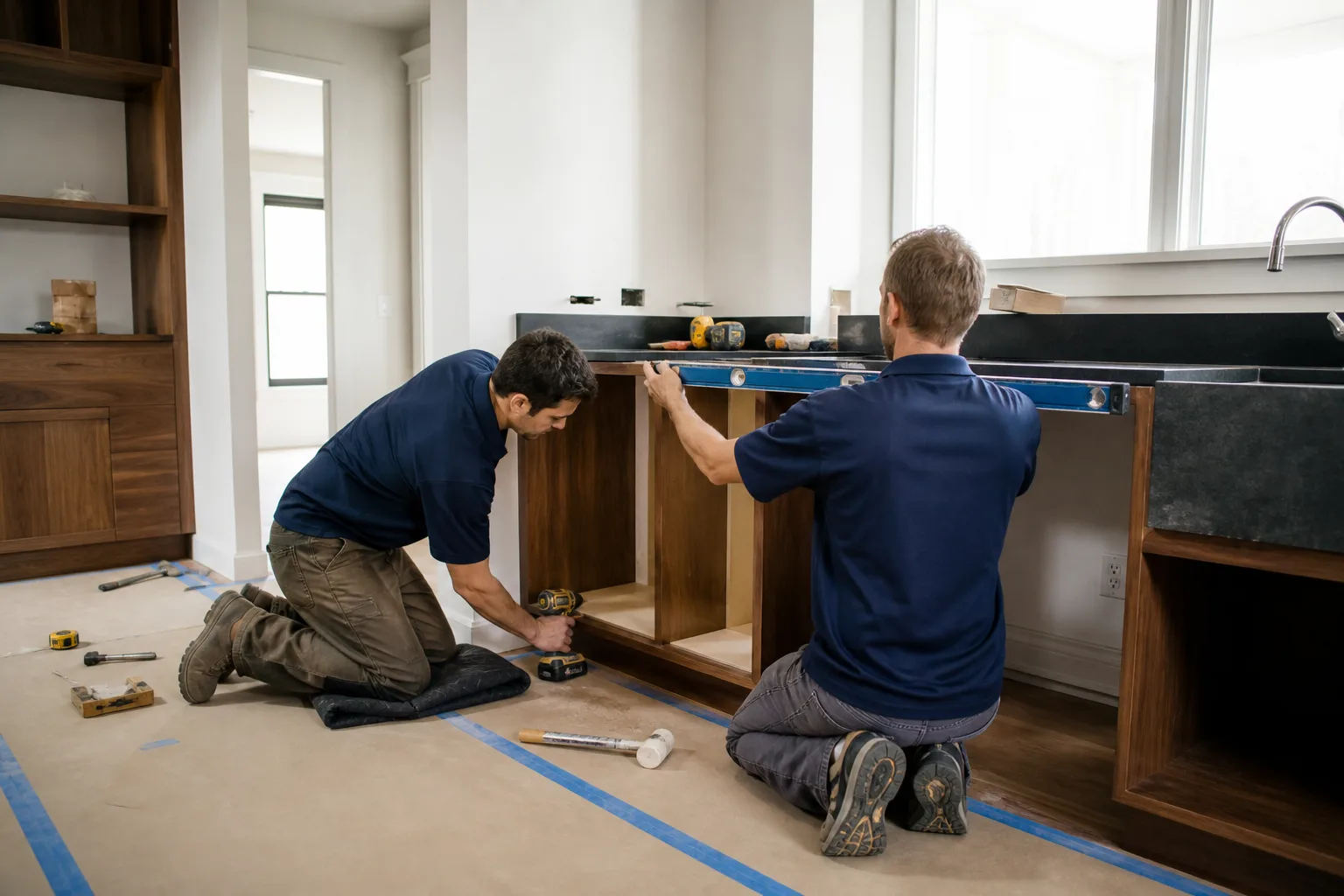
For substrates, we use the same spec on every Cambria install: 3 cm slabs set directly on shimmed and leveled cabinetry, bonded with a two-part adhesive, with seams filled using Cambria’s color-matched epoxy. No shortcuts, no mastic in place of proper adhesive, no skipping the seam color match. We also handle KraftMaid cabinetry for the bases, which pairs cleanly with Cambria when we’re doing a full addition or ADU kitchen.
Styles & brands we work with







Signs Your Cambria Home Additions & ADU Is Failing
Cambria itself rarely fails as a material. What fails is the installation, the substrate, or the planning that went into it. Here’s what we see across Sacramento additions and ADUs:
- A seam you can feel with a fingernail or a credit card. Cambria seams should be flush and nearly invisible when done correctly. A raised or separated seam means the adhesive has failed or the slabs were never properly shimmed during set. Over time, Sacramento’s dry air causes the underlying wood to shrink, which pulls the seam apart further.
- Cracking or chipping at an unsupported overhang. Cambria overhangs beyond 12 inches need corbels or a steel support bracket. When an original installer skipped that support, the counter will crack at the stress point, usually right where the overhang meets the cabinet face. We see this on breakfast bars in older Sacramento additions all the time.
- Water staining or swelling around the sink or faucet. Cambria is non-porous, so water goes where the install allows it. If the sink reveal wasn’t properly caulked, or the faucet holes weren’t sealed, water wicks into the cabinet and substrate below. The counter looks fine; the cabinet is quietly rotting.
- Visible color difference between the original counter and the new addition’s counter. This is a planning failure, not a material failure. Someone ordered the right design name from a different batch and hoped nobody would notice. In daylight, it never matches.
- Cambria that was cut on-site with visible dust lines or a rough edge profile. Cambria is a quartz product and should be cut with a water-fed diamond blade. Dry cutting leaves a chalky white residue that never fully cleans off and weakens the edge. If you see that, the installer cut corners.
Each of these points to the same reality: the failure is almost never the Cambria slab itself. It’s the installation, the substrate prep, or the spec. That’s why Bradford Remodeling Co Sacramento puts every price and every guarantee in writing before a single tool comes out. We want you to know what you’re getting, and we want the record to show it.
See the difference
 Before
 After
After Before
 After
After Before
 After
AfterReplacement Cost & What’s Included
For a Cambria-focused home addition or ADU in Sacramento, the structure lands between $45,000 and $130,000 depending on square footage, foundation type, roof tie-in, and finish level. The Cambria surface work inside that addition adds $2,000 to $6,500 for a typical kitchen with island, or $800 to $3,000 for a bathroom vanity top and backsplash. Here’s how that Cambria piece breaks down:
- Cambria slab material: $65 – $120 per square foot, depending on design and thickness.
- Fabrication and cutting: templating, water-jet cutting, edge profile, and sink/faucet cutouts.
- Installation: leveling, shimming, adhesive, seam matching, and color-matched epoxy.
- Disposal and haul-off: removal of the old counter and any failed substrate, if applicable.
We don’t give verbal numbers that drift. At Bradford Remodeling Co Sacramento, the written price you get up front is the price you pay. No change orders for material delivery, no fuel surcharges, no “we found something behind the wall” reprice. If the job scope changes, we write it down and you approve it before work continues. Every completed Cambria project carries the 365-Day Done Right Promise: if the work fails within one full year of completion, we return and correct it at no charge. That’s a written guarantee, not a handshake.
DIY or Call Us?
Cambria is a 3 cm quartz slab. It weighs roughly 18 to 20 pounds per square foot. A standard 9-foot island top can hit 450 pounds. That’s not a weekend project with a buddy and a pickup truck. The material itself is not dangerous in the way a high-tension garage spring or a live electrical panel is, but the weight and the precision cutting are. A dropped slab can crush a foot, shatter on a tile floor, or twist wrong while you’re setting it and break the seam you spent two hours aligning.
What you can do safely is document what you have: measure the linear footage of the existing counters, note the Cambria design name from any remaining paperwork or the slab label under the counter, take photos of the edge profile and seam locations, and call us with that information. We’ll come out, template the space, and give you a written quote. The days of guessing are over. Call (279) 226-1509 and we’ll get it measured, quoted, and scheduled.
FAQs
A properly installed Cambria counter will outlast the cabinets it sits on, typically 20 to 30 years or more, because quartz does not stain, etch, or wear the way natural stone does. Sacramento’s dry climate actually helps here: there’s less humidity cycling the wood substrate, so properly shimmed and supported counters stay stable. The failure point is almost always the install, not the material. Call (279) 226-1509 if you’re not sure what you have.
A separated seam can often be re-bonded and color-matched with Cambria’s epoxy system, but only if the slab is not cracked and the substrate below is still sound. If the underlying cabinet has rotted or the slab has stress cracks at an overhang, the honest answer is replacement. We’ll tell you which one you’re looking at when we inspect it. Estimates are free: (279) 226-1509.
Once the cabinetry is set and the space is ready for templating, the Cambria piece typically runs 2 to 3 weeks from template to finished install, with the actual on-site installation done in one day. The longer lead time is because we order your specific design and batch, then schedule fabrication. On a full addition or ADU, the Cambria goes in near the end of the project, after cabinets, plumbing rough-in inspection, and paint.
We order Cambria per project, matched to your design name and current batch, because stocking full slabs of every design would mean you’re getting whatever’s been sitting in a warehouse, not the batch that matches your main house. What we do keep is the installation consumables: the right two-part adhesive, color-matched epoxy kits, and the support brackets for overhangs. When you call Bradford Remodeling Co Sacramento, we’ll spec the Cambria and tell you exactly what it costs. Call (279) 226-1509.
Written by Curtis Lane, Owner, Bradford Remodeling Co Sacramento at Bradford Remodeling Co Sacramento, serving Sacramento and nearby areas.


