

Last updated October 16, 2026







Free written scope consultation - allowances, timeline, and change-order rules on paper before a single trade is scheduled
Construction Warning Signs: A Sacramento Homeowner’s Reference Guide
The most expensive contractor mistake Sacramento homeowners make isn’t hiring someone unlicensed. It’s signing a contract with no defined change order procedure and then watching a $45,000 kitchen remodel settle at $67,000 with no single line item they can legally dispute. The contractor didn’t break the law. He simply left the door open, and the homeowner walked through it without knowing the hinges were missing. This guide teaches you to read a bid and a contract the same way a general contractor reads a subcontractor’s proposal: looking for what’s missing, not what’s promised. For more on this process, see our step-by-step guide to hiring a construction contractor in Sacramento. By the time you finish, you’ll know which documents signal discipline and which ones signal a financial argument waiting to happen. That’s the difference between a remodeling project in Sacramento that closes on budget and one that never really closes at all.
Styles & brands we work with







Quick Answer
The warning signs that a Sacramento contractor will cost you money live in the paperwork, not the pitch. A bid with an undefined allowance, a contract with no change order clause, a payment schedule front-loaded beyond the 10% or $1,000 California legal cap, or a contractor who discourages competitive bids is telling you exactly how the money conversation will go once work starts: badly. Read the documents first, and you’ll know the contractor before he ever picks up a hammer.
Table of Contents
- Document Red Flags: What the Paper Reveals Before a Tool Is Lifted
- Behavioral Red Flags: What Pressure Looks Like in a Kitchen Conversation
- On-Site Red Flags: What the Job Site Tells You the Bid Never Will
- Financial Red Flags: Draw Schedules, Cash Requests, and the 10% Rule
- How to Document a Contractor Dispute in Sacramento: CSLB, Arbitration, and Small Claims
- How to Read a Bid Like a General Contractor Reads a Sub’s Proposal
- Change Orders: The One Clause That Separates a Bad Deal From a Disciplined One
- The Garrison Standard: What “Squared Away” Looks Like on Paper
- Common Mistakes to Avoid
- When to Call a Professional
- Frequently Asked Questions
- The Bottom Line
Before we go further, a quick note on how we operate. Bradford Remodeling Co Sacramento home has worked inside the Sacramento remodeling market since 2004. We don’t write guides like this to scare homeowners. We write them because we’ve fixed too many projects that started with a handshake and ended with a lien. The Garrison Standard, the framework behind every job we run, exists precisely because the problems in this guide are real, recurring, and preventable. If you’re planning a kitchen remodeling project in Sacramento, or any whole-home work, read the warning signs below. Then call us. The estimate is free. The education is too.
Document Red Flags: What the Paper Reveals Before a Tool Is Lifted
A contractor’s bid is a financial document, not a sales brochure. The way it’s structured tells you how the contractor manages money, scope, and accountability. Most homeowners read a bid for the bottom line. A general contractor reads it for what’s absent. Here’s what missing language actually signals.
An allowance with no definition. “Allowances” in a remodeling bid are placeholders for materials the contractor hasn’t priced yet: flooring, fixtures, countertops. That’s normal. The red flag is an allowance with no dollar figure attached and no specification of what it covers. If your contractor writes “Allowance for tile” and moves on, you have no idea whether the number assumes $4 per square foot or $14. The bid looks cheaper than it is. When you inevitably pick a $9 tile, the “surprise” line item appears. A disciplined bid defines each allowance: “Tile allowance: $7.50/sq ft, materials only, installation separate.” Every dollar you don’t see defined is a dollar you’ll negotiate later, after the work has started and your leverage is gone.
No exclusion list. A complete scope of work includes what the contractor will NOT do. No painting. No debris hauling beyond a certain dumpster size. No appliance installation beyond the cost of setting units. When an exclusion list is missing, the contractor has room to interpret. The cleanup clause becomes a debate. The appliance hookup becomes an argument. A bid without exclusions is a bid with implied inclusions, and implied inclusions are the contractor’s best friend in a dispute, because the homeowner can’t prove what was promised. Sacramento contractors who run disciplined shops write exclusions because they’ve been burned by them. The ones who don’t write them haven’t learned to manage their own scope yet. That inexperience lands in your invoice.
No payment schedule. California law caps the down payment on most residential remodeling contracts at 10% of the project cost or $1,000, whichever is less. That’s a hard number, not a courtesy. But the law doesn’t dictate the rest of the schedule. A bid that lists only a total price and a deposit, with no draw schedule tied to project milestones, is a bid from a contractor who hasn’t thought through his own cash flow. That means he’s financing your project by borrowing from it. When a contractor’s cash position is shaky, he starts making decisions based on what he’s owed, not what the job requires. Work stalls. Materials get substituted. The schedule starts sliding. Then the change orders start appearing, because the contractor needs cash and the only way to get it is to invent scope he didn’t anticipate. Sacramento homeowners who’ve done one project already know this pattern. They can tell you exactly what it cost them.
Vague materials language. “Quality countertops.” “Premium fixtures.” “Nice cabinets.” These words mean nothing in a contract. They’re placeholders for whatever the contractor can source cheapest when the time comes. We install name-brand materials with documented manufacturer specifications: Cambria and Caesarstone surfaces, Kohler and Moen fixtures, KraftMaid and Wellborn cabinetry, GAF and James Hardie exterior products, Therma-Tru doors. When a brand is written into the bid, the material is traceable. The warranty is real. The quality is not left to guesswork. A contractor who won’t name brands is reserving the right to buy from whatever supplier cuts him the best margin that week. That’s not necessarily dishonest. It’s just not your interest he’s protecting.
Behavioral Red Flags: What Pressure Looks Like in a Kitchen Conversation
The contractor’s behavior before the contract is a live preview of his behavior after it. Sacramento homeowners tend to assess personality: is he friendly, does he show up on time, does he return calls. Those things matter. But the deeper tells are in how the contractor handles the sales conversation itself.
Same-day pressure. A contractor who wants a signature before you’ve had time to get a second bid is telling you his business model depends on speed, not comparison. That’s a structural problem. A remodeling contractor with a full pipeline and a healthy margin doesn’t need to close in one sitting. He can hand you a written bid, answer your questions, and let you think about it, because he knows his price is defensible. A contractor who says “I can hold this price for you but only if we sign today” is not doing you a courtesy. He’s doing himself a hedge. He knows the price won’t hold up under scrutiny, so he’s removing the scrutiny. Never sign a remodeling contract the day it’s presented. Never. A real professional at a general contractor serving Sacramento expects you to compare bids. The ones who don’t expect it are the ones you should walk away from.
Discouraging other bids. This is a cousin of same-day pressure, but it’s more subtle. The contractor doesn’t push for a signature. He instead plants doubt: “Other contractors will underbid this just to get the job and then hit you with change orders,” or “You’ll waste three weekends getting quotes.” That’s a contractor trying to be your only data point. A homeowner who never sees another bid can’t evaluate whether $45,000 is fair for a kitchen. The contractor knows this. He’s not educating you. He’s isolating you. In Sacramento’s remodeling market, where price variation for identical scopes can run 30% or more, skipping comparative bids is the single most expensive mistake a homeowner can make after signing an unbounded contract. Our DIY vs Professional Construction guide for Sacramento homeowners explores when professional help pays for itself.
Handshake language. “Don’t worry, we’ll take care of it.” “I’ll make sure my guys handle that.” “We’ve never had a problem.” These are promises with no paper. They mean nothing in a dispute, and Sacramento has more contractor disputes than most metro areas of its size because of the age of its housing stock and the volume of remodels. A contractor who resists putting verbal promises into writing is telling you he doesn’t want a record. The Garrison Standard exists because verbal promises fail. We put every price and every guarantee in writing before a single tool comes out. Not because we don’t trust our own word. Because a written commitment is the only commitment a homeowner can actually hold.
No permit talk. When a contractor doesn’t mention permits during the sales conversation, that’s a flag. Permits are required for most structural, electrical, plumbing, and HVAC work in Sacramento, and the permitting process shapes the schedule and the budget. A contractor who skips permit talk is either planning to work without them, planning to leave them to you, or hasn’t priced them. All three are problems. A contractor who mentions permits in the first conversation, explains which ones apply to your scope, and tells you who pulls them is signaling that he runs a legal job site. Not everyone does.
On-Site Red Flags: What the Job Site Tells You the Bid Never Will
The project has started. The contract is signed. The deposit is paid. Now what tells you the project is heading sideways before the invoice shows up? The job site itself.
Permits pulled late. If tear-out starts before the permit card is posted, the contractor is working illegally. That’s not a paperwork nuance. A stop-work order from the Sacramento building department can freeze your project for weeks while inspections get sorted out. Worse, work done before a permit is issued may have to be torn out and redone for the inspector to sign off. A contractor who starts before the permit is posted is telling you he values schedule over compliance. That’s a dangerous priority in a city with Sacramento’s inspection load. Posting the permit card is a ten-second act that demonstrates the contractor respects the process. Its absence is a signal that he doesn’t.
Subcontractors who appear without introduction. Most remodeling projects involve subs: electricians, plumbers, tile setters, drywallers. A disciplined contractor introduces each sub, explains their scope, and confirms they’re licensed, insured, and background-checked where required. A contractor who has a stranger knocking on your door at 7 a.m. with no introduction is not managing his site. He’s dispatching bodies. You, the homeowner, are the one who has to live with whoever’s in your house. At Bradford Remodeling, every technician who walks through your door is background-checked and uniformed. You know who’s coming before they arrive. That’s not a luxury. It’s a baseline standard for a professional job site, and it’s one of the elements of The Garrison Code that every Garrison Partners location follows.
Material substitutions without notice. The bid specified James Hardie siding. The truck pulls up with a different brand. The bid specified Moen fixtures. The boxes in the garage are something else. When materials arrive that don’t match the written specs, and nobody called you to explain, the contractor has made a unilateral decision about your project. That decision may be cost-driven, availability-driven, or simply careless, but it’s yours to approve, not his to make. A contractor who substitutes materials without conversation is a contractor who makes decisions without consultation, and that behavior pattern extends to every aspect of the job.
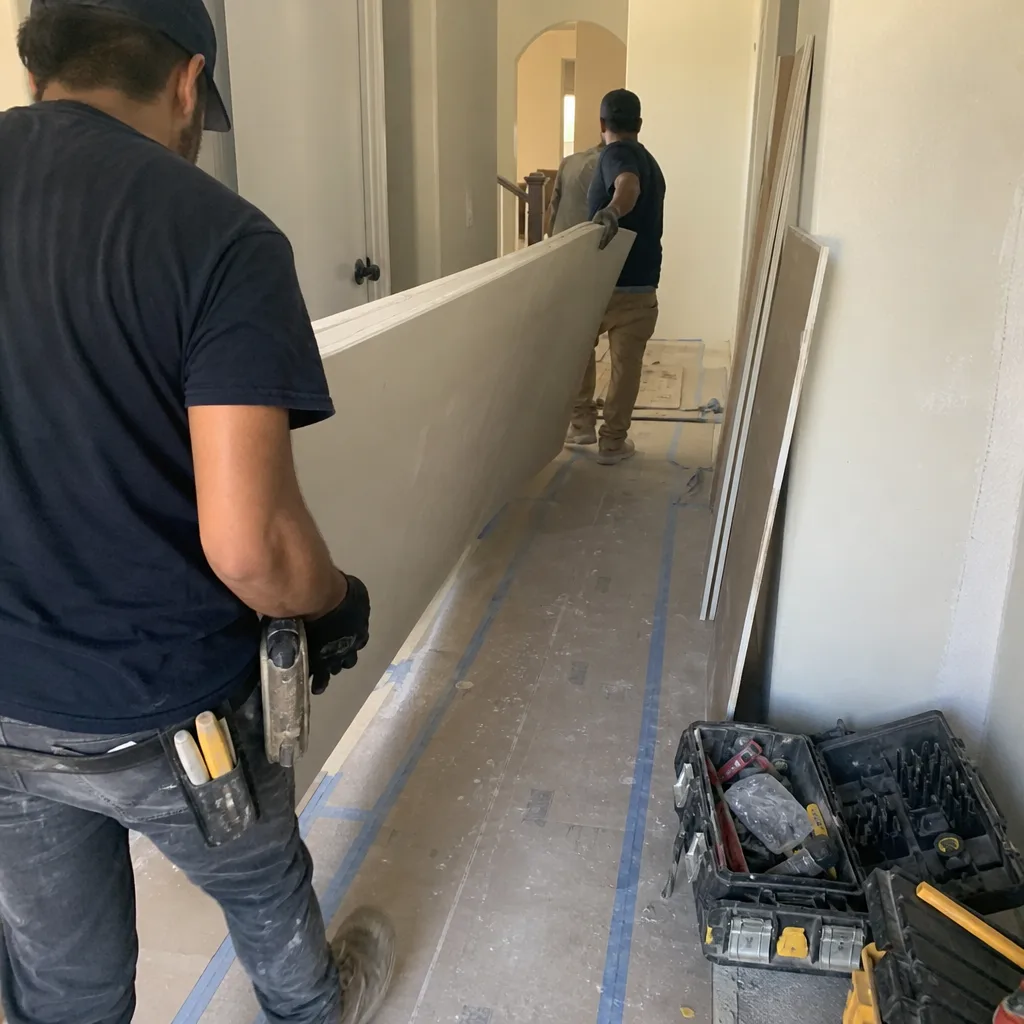
Mess and disorganization. A job site doesn’t have to be spotless. Demolition is messy. But there’s a difference between construction debris and chaos. A contractor who leaves food wrappers, doesn’t protect floors, scatters tools, and doesn’t contain dust is showing you his standard of care. That standard applies to the work you can’t see too. The drywall patch that’s never properly sanded. The insulation stuffed hastily. The flashing installed wrong. When a crew doesn’t care about the visible site, they don’t care about the concealed work either. We’ve seen it in Sacramento homes across every neighborhood, from East Sacramento to Natomas: a job site that looks like a war zone produces work that performs like one.
Financial Red Flags: Draw Schedules, Cash Requests, and the 10% Rule
Money talks in a remodel. The way a contractor asks for it tells you more than anything he says. Here’s what to watch.
Front-loaded draw schedules. A draw schedule is a series of payments tied to project milestones: deposit, rough-in complete, drywall hung, final walkthrough. A front-loaded schedule asks for too much money too early. If your $60,000 kitchen remodel is scheduled to pay out $45,000 by the time cabinets are ordered, the contractor has been paid for work he hasn’t completed. At that point, he has no financial incentive to finish. He has your money, and you have an unfinished kitchen. A disciplined draw schedule keeps payments slightly behind the value of completed work. That protects both parties. The contractor has enough cash to keep the job moving. The homeowner retains enough leverage to ensure the job actually finishes.
Cash payment requests. California law doesn’t prohibit cash payments, but a contractor who wants cash, especially large amounts, is often avoiding a paper trail. No check, no card, no documented transfer. When there’s no record of payment, there’s no proof of payment in a dispute. A contractor who asks for cash is also often unlicensed or working off the books, because licensed contractors know that documented payments protect them too. Don’t pay for remodeling work in cash. Ever. Write the check, or use a bank transfer. Keep the record. If the contractor balks at that, take it as the red flag it is.
The 10% or $1,000 rule. California Business and Professions Code section 7159 caps the down payment on most residential home improvement contracts at 10% of the total project cost or $1,000, whichever is LESS. That’s not a guideline. It’s a statute. A contractor who asks for 30% down to “cover materials” on a $50,000 project is violating state law, and a contractor willing to violate state law before the project starts will violate other things once it’s underway. The law exists specifically because front-loaded payments create lopsided risk. The contractor has your money and your house. You have an unfinished project and no leverage. When we write a bid for a home remodeling project in Sacramento, the payment terms are printed on the document. The deposit follows the legal cap. The draw schedule is tied to milestones. There’s no ambiguity, and there’s no renegotiation at the door.
Requests for extra money outside the change order process. A legitimate cost overrun goes through the change order process: written description of the changed scope, written price, your signature before the work proceeds. A contractor who asks for “a little extra” verbally, outside that process, is testing your boundaries. He’s seeing whether you’ll pay without documentation. The first time you do, the second request is bigger. The Change Order section below explains what a real change order looks like and why it’s the single most important clause in your contract.
How to Document a Contractor Dispute in Sacramento: CSLB, Arbitration, and Small Claims
Sometimes the red flags appear too late, or they were missed entirely. Now you have a problem. Here’s the Sacramento-specific path to resolution, in order.
- Write everything down. Start a project log. Date. Time. Who said what. Take photos of the work, the site, the materials. Save every text, every email, every invoice. In a dispute, documentation is the difference between winning and losing. Start the log the day you suspect something’s wrong, not the day you decide to fight.
- Communicate in writing. Send a written summary of the issue to the contractor. List the concerns, reference specific contract terms, and request a response by a reasonable date. This does two things. It preserves your version of events in a discoverable format. And it gives the contractor a chance to fix the problem before the dispute escalates. Many disputes end here, with a written agreement to correct the work.
- File with the Contractors State License Board (CSLB). The CSLB regulates contractors in California. You can file a complaint online. The CSLB will investigate licensing violations, illegal advertising, poor workmanship, and abandonment. They can discipline a contractor’s license, require corrective work, and in some cases order restitution. A CSLB complaint is not a lawsuit, but it applies regulatory pressure. Contractors care about their license. The threat of CSLB action motivates a lot of corrective behavior that friendly phone calls don’t.
- Use CSLB arbitration. For disputes up to $50,000, the CSLB operates a mandatory arbitration program. The contractor is required to participate as a condition of their license. Arbitration is faster and less expensive than court, and the decision is binding. This is often the most practical path for a Sacramento homeowner with a mid-sized dispute.
- Small claims court. Sacramento County small claims court handles disputes up to $12,500 for individuals. You don’t need a lawyer. You present your documentation, the contractor responds, and a judge decides. Small claims is designed for exactly the kind of disputes homeowners have with contractors: poor workmanship, incomplete scope, unauthorized charges. The filing fee is modest, the process is straightforward, and the judge will read your contract. Bring the written everything.
- Civil litigation. For disputes above the small claims threshold, or for cases involving fraud or significant damages, civil court is the last resort. It’s expensive, slow, and emotionally exhausting. Most Sacramento contractor disputes resolve before they reach this stage. The homeowners who prevail in litigation are the ones who documented everything from day one.
How to Read a Bid Like a General Contractor Reads a Sub’s Proposal
A general contractor evaluating a subcontractor’s proposal looks for the places where scope can hide. Homeowners should do the same with a remodeling bid. Here’s the sequence.
- Find the allowance definitions. Every allowance should have a dollar figure and a specification. If an allowance says “TBD,” you don’t have a bid yet. You have a conversation.
- Read the exclusions. If there’s no exclusion list, ask for one in writing. A contractor who can’t tell you what he’s NOT doing hasn’t defined what he IS doing.
- Check the payment schedule. Confirm the deposit follows the 10% or $1,000 cap. Confirm draw payments are tied to visible milestones, not dates on a calendar.
- Verify materials. Brands should be named. If the bid says “premium” or “quality,” ask what that means in a product name. If the contractor won’t answer, that’s your answer.
- Look for the change order clause. This is covered in the next section. If it’s missing, the bid is incomplete, and the contract will be too.
- Compare the bid against the contract. A bid and a contract should match. If the bid promised something the contract doesn’t include, the contract wins. Read them side by side.
Sacramento homeowners have a particular vulnerability here because of the city’s permitting requirements and the age of its housing stock. Older homes hide structural surprises. A bid written without accounting for Sacramento’s specific code environment, seismic requirements, or aging infrastructure is a bid written by a contractor who hasn’t worked here long enough to know what’s behind the walls. Ask the contractor about Sacramento-specific issues: title 24 energy requirements, seismic retrofit considerations, the age of your electrical panel. A contractor who can’t speak to those things has shown you something important. For a complete checklist of what to verify, see our General Contractor Maintenance Checklist for Sacramento Homeowners.
Change Orders: The One Clause That Separates a Bad Deal From a Disciplined One
This is the most important section in this guide. If you read nothing else, read this.
Every remodeling project encounters surprises. A wall opens to reveal plumbing that needs repair. The homeowner changes their mind about the backsplash. The city inspector requires a modification. These are normal. The difference between a project that absorbs them and a project that collapses under them is the change order procedure written into the contract before work begins.
A change order is a written amendment to the contract. It describes the changed scope, lists the price, and requires your signature before the work proceeds. The procedure is simple: the contractor identifies a condition that requires a change, prices it in writing, presents it to you, and waits for your approval. You approve it or you don’t. If you approve, the work changes and the price adjusts. If you don’t, the contract stands as written.
The contract that’s missing this clause has a hole. Without a defined change order procedure, every surprise becomes a negotiation. The contractor does the work, then sends you an invoice. Or the contractor starts work, then stops and asks for more money, and you have no framework to evaluate the request. The $45,000 kitchen becomes $67,000 through a series of small, verbally approved additions, none of which you signed, all of which you now owe.
A real change order clause covers at least these elements:
- Any change to scope or price must be documented in writing.
- Work on changed scope doesn’t start until the homeowner signs the change order.
- The change order lists the specific price impact, including any schedule impact.
- No verbal agreements are enforceable.
When we run a kitchen remodel in Sacramento, the change order process is printed in the contract. Our 365-Day Done Right Promise sits alongside it. The promise is simple: if the work doesn’t hold within a year, we return and correct it at no charge. But the promise only means something alongside a disciplined contract. A written guarantee is only as good as the document it’s attached to. That’s the Garrison Standard. Everything in writing. Everything defined. Nothing left to interpretation.
The Garrison Standard: What “Squared Away” Looks Like on Paper
You’ve now read several hundred words about red flags. Here’s what the absence of red flags looks like, in specific, observable terms.
The Garrison Standard is the framework behind every Bradford Remodeling Co Sacramento project. We’re part of the Garrison Partners family, established in 2004, and every location operates as an independently owned business held to the same Standard. Here’s what that means in practice.
Written price before work starts. Not an estimate. A written price. The number doesn’t move at the door, and the payment schedule is part of the document. You sign one thing, and that’s the thing we build.
Documented materials. We install premium brands with manufacturer specs and warranties that back our own guarantee. KraftMaid and Wellborn cabinetry. Cambria, Silestone, and Caesarstone surfaces. Kohler and Moen fixtures. GAF, CertainTeed, and Owens Corning roofing. James Hardie siding. Therma-Tru doors. Belgard and Unilock hardscaping. Tamko, Boral, PGT, and CGI where the project calls for them. The brands are in the bid. You don’t wonder what you’re buying.
Background-checked, uniformed technicians. The people who walk through your door are the people we’ve vetted. They arrive in uniform. They know the scope. Identity and conduct standards are set at the Garrison Partners level, not ad hoc at the job site. You know who’s in your house before they arrive.
365-Day Done Right Promise. Every completed project carries a full-year written guarantee. If the work fails inside that window, Bradford returns and corrects it at no charge. The promise is written, not spoken. It’s in the contract, next to the price, next to the scope.
Live-person phone coverage 24/7. A real person answers the phone. No automated systems. Call at 2 a.m., you get a voice, not a menu. That matters when a leak appears in a just-remodeled bathroom and you need to know what to do.
Squared-away close. At job close, here’s what you’ll have: a clean site, a documented scope that matches the completed work, and a signed written guarantee in your hand. No mystery. No “we’ll circle back on that.” The project is finished when the paper says it’s finished, and the paper matches the work.
Common Mistakes to Avoid
- Signing the day you get the bid. You have the right to think. A contractor who doesn’t respect that right is showing you who he’ll be when things go wrong. Take at least a few days. Get another bid.
- Ignoring the change order clause. If the contract doesn’t define how changes are priced and approved, every surprise becomes a dispute. Demand the clause before you sign. This is the single highest-impact thing you can do.
- Paying above the legal deposit cap. The 10% or $1,000 rule is not optional. A contractor who asks for more is either unlicensed, uninformed, or unethical. None of those are people you want inside your walls.
- Accepting “allowance” with no dollar figure. An undefined allowance is a blank check. Define every allowance in writing, or don’t sign.
- Skipping the permit conversation. In Sacramento, most structural work requires permits. A contractor who avoids the subject is planning to avoid the law. Permits protect you. Don’t waive them.
- Not documenting from day one. You can’t reconstruct a paper trail after the dispute starts. Start the log the day the contract is signed. Photos, texts, emails, invoices. Everything.
- Hiring on a handshake. “We’ll work it out.” “Don’t worry about it.” These are not contract terms. A professional puts it in writing because a professional expects to be held to it. If it’s not in the paper, it doesn’t exist.
When to Call a Professional
Some remodeling work is genuinely dangerous to attempt yourself. We’re not talking about paint colors. High-tension garage-door springs, electrical panel work, gas line modifications, structural alterations, steep-roof work: these can cause serious injury or death. A licensed professional carries the training, the tools, and the insurance. If the work involves load-bearing walls, live electrical, or gas connections, call someone who does it daily. The cost of a professional is cheaper than the cost of a hospital stay or a house fire.
Beyond safety, call a professional when you want the paper to be right. A remodeling project is a legal contract, not just a construction job. The documents matter as much as the drywall. Bradford Remodeling Co Sacramento offers free estimates in Sacramento. Call (279) 226-1509. We’ll walk the site, write the scope, and give you a number in writing. Whether you hire us or not, you’ll leave the conversation knowing what a disciplined bid looks like. For more guides & resources on navigating your remodeling project, visit our blog.
Frequently Asked Questions
For most residential home improvement contracts, California law caps the down payment at 10% of the total project cost or $1,000, whichever is less. Any contractor asking for more than that before work begins is operating outside the legal limit. On a $45,000 remodel, the legal maximum deposit is $1,000. If someone asks for $15,000 up front, walk away. Call (279) 226-1509 if you want to see how a legally compliant payment schedule is structured.
A remodeling contract should include the full scope of work, line-item pricing, defined allowances, an exclusion list, a payment schedule that follows the California cap, a written change order procedure, named material brands, the permit plan, and the warranty terms. If any of those elements is missing, the contract is incomplete and the risk has shifted to you. Call (279) 226-1509 for a free estimate that includes all of them.
A change order is a written amendment to the contract that documents a change in scope, price, or schedule and requires the homeowner’s signature before the changed work begins. It matters because it’s the only legal protection you have against a surprise invoice at the end of the project. Without a change order procedure, verbal approvals become unbounded costs. With one, every dollar is documented.
Start by documenting everything in writing and sending the contractor a written summary of the issue. If that doesn’t resolve it, file a complaint with the Contractors State License Board at cslb.ca.gov. For disputes up to $50,000, use the CSLB arbitration program. For disputes up to $12,500, file in Sacramento County small claims court. The homeowner with documentation wins. The homeowner without it doesn’t.
No. A contractor asking for cash, especially large amounts, is usually avoiding a paper trail. You have no proof of payment in a dispute, and the contractor may be operating off the books. Pay by check or bank transfer, and keep records of every payment. A professional contractor will never object to documented payment.
Ask for material brands in writing. A contractor who specifies brands like Cambria, Caesarstone, Kohler, Moen, KraftMaid, James Hardie, or Therma-Tru is telling you exactly what you’re paying for. A contractor who says “premium quality” without naming a product is reserving the right to buy whatever’s cheapest. Names are traceable. Adjectives aren’t. Call (279) 226-1509 and we’ll show you a written bid with the brands listed.
The Bottom Line
The contractor who will cost you money isn’t always the one with a messy truck and a cheap bid. Sometimes he’s the friendly one with a clean presentation and no change order clause. The tells are in the paper: undefined allowances, missing exclusions, front-loaded draws, no brand names, no permit talk. Sacramento’s remodeling market is full of good contractors and full of the other kind. The homeowners who end up with the good ones learn to read the documents first. That’s the whole game. Read the bid. Read the contract. And if you want to see what a squared-away document looks like, call us. The estimate is free, and it will teach you more than any guide can.
Written by Curtis Lane, Owner at Bradford Remodeling Co Sacramento, serving Sacramento since 2004.
See the difference
 Before
 After
After Before
 After
After Before
 After
After

